
Serving students and faculty for over 40 years
Welcome to the University of Chicago Computer Science Instructional Laboratory (CSIL)!
Since 1985, CSIL has provided students, faculty, and university affiliates with a variety of computing services.
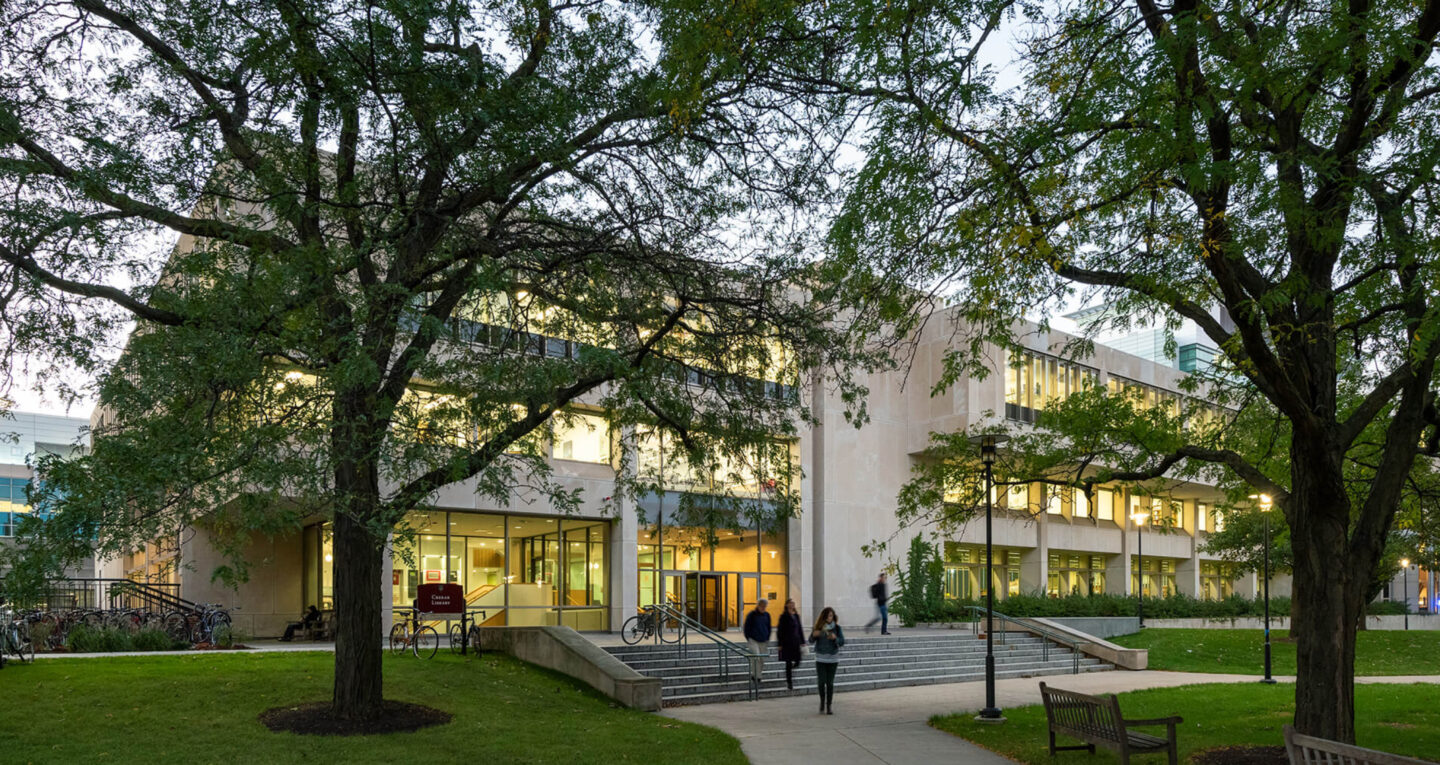
Located on the first floor of the John Crerar Library, CSIL offers a wide range of services - from hardware support to computer software to minicourse lessons.
Contact us if you have any questions or would like to reserve a lab.
Specialized teams keep CSIL running
CSIL's work is organized into specialized teams, each focused on a different area of the lab's operations and services. Together, these teams keep CSIL running and drive new projects forward.
Activity Monitoring
The Activity Monitoring team tracks and analyzes every kind of "activity" in CSIL to surface actionable insights — from lab computer usage to the physical occupancy of our space. The team works across hardware and software to answer questions like "What? When? For how long?"
SAMPLE PROJECTS
- Tracking metrics and processes across all lab computers using Elastic.
- Live-updating the lab's physical occupancy with custom Raspberry Pi and camera setups.
AI/ML
The AI/ML team develops internal technical solutions and leads educational initiatives, building practical applications like in-house chatbots and predictive models trained on lab data. Members get hands-on experience with AI deployment, data analysis, and teaching machine learning concepts to others.
SAMPLE PROJECTS
- CSIL RAG Chatbot: a patron-facing Retrieval-Augmented Generation chatbot trained on scraped CSIL documentation to automate answers to common lab inquiries.
- Time Series Forecasting: predictive ML models trained on macOS application usage data to forecast lab CPU performance and device utilization.
Education & Instruction
The Education-Instruction team promotes CS education both inside and out of UChicago. We collaborate with local high schools to teach an 8 week introductory capstone, offer mini courses by expert staff for the student body, and visit senior centers to help senior citizens with tech basics.
SAMPLE PROJECTS
- Saturdays with CSIL: an 8-week high school capstone focused on the fundamentals of CS.
- Internal Interview Design: refining and designing technical interviews for new CSIL hires.
Fabrication
The Fabrication team handles CSIL's hardware needs and takes on the more hands-on projects across the lab. Its largest asset is the Bambu 3D printers, but the team also works with Arduino and a range of programming languages.
SAMPLE PROJECTS
- CSIL Shhh: built decibel meters to monitor lab volume using Arduino and C++, with a custom 3D-printed housing.
- Learn 2 Model: workshopped 3D modeling in Autodesk Fusion 360 and 3D-printed intricate designs as proof of concept.
Imaging
The Imaging team manages and secures CSIL's fleet of Macs and Windows PCs using tools like Jamf and Ansible, handling everything from device policy to packaging and deploying software for coursework, RSOs, and workshops. It's a good fit for students interested in IT infrastructure, endpoint engineering, and systems administration, with hands-on experience in Bash and PowerShell.
SAMPLE PROJECTS
- Packaging and deploying third-party software — 3D printer drivers, Adobe, VSCodium, and more — to 40+ Macs through Jamf.
- Scripting nightly backup and cleanup of Active Directory user data across lab machines with a 24-hour recovery window.
- Building and testing a network lockdown system for exam proctoring.
Inventory
The Inventory team maintains CSIL's central asset — our physical inventory resources. Beyond keeping the right resources available for patrons when they need them, the team develops internal software and hardware tools to track, manage, and analyze the lab's physical resource usage.
SAMPLE PROJECTS
- Keeping physical resources (chargers, adapters, cables) stocked and in good condition.
- Developing an API that exposes checkout system data to other teams.
- Tracking checkout statistics across the lab.
- Building Windows services that enforce checkouts on lab PCs.
SemaDoc
The SemaDoc team builds software tools and infrastructure that improve lab tutor productivity. It began as a project focused on using AI for documentation — streamlining workflows, maintaining consistency between tools like Trello and the wiki, and generating more structured docs and data for AI-related tasks.
SAMPLE PROJECTS
- SemaDoc: our in-house AI documentation tool.
Servers
The Servers team manages CSIL's backend infrastructure and deployments using Docker, handling everything from spinning up new containers to maintaining system reliability. It's an ideal fit for students eager to gain hands-on DevOps experience and manage real-world server environments.
SAMPLE PROJECTS
- Maintaining Docker deployments across CSIL's backend infrastructure.
- Deploying new projects and tech stacks as the lab's needs evolve.
Web-Int
The Web-Int (Web Internal) team builds the software designated for CSIL's internal use, including scheduling tools, dashboards, and automations. The team collaborates on full-stack projects, gaining web development experience while improving lab operations through thoughtful design and continuous iteration.
SAMPLE PROJECTS
- CSIL Tutor Schedule: a Rust-based scheduling system that manages tutor shifts and cleaning assignments, with automated shift logic based on tutor availability.
- Lab Dashboard: a central view of machine status and lab activity, with Slack integrations for reporting issues around the lab.
Website
The Website team maintains CSIL's public-facing site using Next.js, handling everything from routine updates to full redesigns. It's a good fit for students who want real ownership over a production codebase.
SAMPLE PROJECTS
- Site Redesign: rebuilt the CSIL public site from the ground up in Next.js, with a refreshed visual identity, faster page loads, and a fully responsive layout.